

Solved
NIFI-1.16.0 insufficient permissions while performing any action
HI Team,
System Env Details: I am trying setup NIFI on AWS
3 node cluster
NIFI version: 1.16.0
authorisers.xml :
<userGroupProvider>
        <identifier>file-user-group-provider</identifier>
        <class>org.apache.nifi.authorization.FileUserGroupProvider</class>
        <property name="Users File">./conf/users.xml</property>
        <property name="Legacy Authorized Users File"></property>
        <property name="Initial User Identity 1">xxx@xxx.com</property>
        <property name="Initial User Identity 2">C=US, ST=xxx, O=xxx, OU=xxxx, CN=%%cn_user_identity_1%%</property>
        <property name="Initial User Identity 3">C=US, ST=xxx, O=xxx, OU=xxxx, CN=%%cn_user_identity_2%%</property>
        <property name="Initial User Identity 4">C=US, ST=xxxxx, O=xxxx, OU=xxxx, CN=%%cn_user_identity_3%%</property>
    </userGroupProvider>


 <accessPolicyProvider>
        <identifier>file-access-policy-provider</identifier>
        <class>org.apache.nifi.authorization.FileAccessPolicyProvider</class>
        <property name="User Group Provider">file-user-group-provider</property>
        <property name="Authorizations File">./conf/authorizations.xml</property>
        <property name="Initial Admin Identity">xxxx@xxxxx.com</property>
        <property name="Legacy Authorized Users File"></property>
        <property name="Node Identity 1">C=US, ST=xxx, O=xxx, OU=xxx, CN=%%cn_node_identity_1%%</property>
        <property name="Node Identity 2">C=US, ST=xxx, O=xx, OU=xxx, CN=%%cn_node_identity_2%%</property>
        <property name="Node Identity 3">C=US, ST=xxxx, O=xxxxx, OU=xxxx, CN=%%cn_node_identity_3%%</property>
        <property name="Node Group"></property>
    </accessPolicyProvider>
nifi.properties
# Core Properties #
nifi.flow.configuration.file=./conf/flow.xml.gz
nifi.flow.configuration.json.file=./conf/flow.json.gz
nifi.flow.configuration.archive.enabled=true
nifi.flow.configuration.archive.dir=./conf/archive/
nifi.flow.configuration.archive.max.time=30 days
nifi.flow.configuration.archive.max.storage=500 MB
nifi.flow.configuration.archive.max.count=
nifi.flowcontroller.autoResumeState=true
nifi.flowcontroller.graceful.shutdown.period=10 sec
nifi.flowservice.writedelay.interval=500 ms
nifi.administrative.yield.duration=30 sec
# If a component has no work to do (is "bored"), how long should we wait before checking again for work?
nifi.bored.yield.duration=10 millis
nifi.queue.backpressure.count=10000
nifi.queue.backpressure.size=1 GB

nifi.authorizer.configuration.file=./conf/authorizers.xml
nifi.login.identity.provider.configuration.file=./conf/login-identity-providers.xml
nifi.templates.directory=./conf/templates
nifi.ui.banner.text=
nifi.ui.autorefresh.interval=30 sec
nifi.nar.library.directory=./lib
nifi.nar.library.autoload.directory=./extensions
nifi.nar.working.directory=./work/nar/
nifi.documentation.working.directory=./work/docs/components

####################
# State Management #
####################
nifi.state.management.configuration.file=./conf/state-management.xml
# The ID of the local state provider
nifi.state.management.provider.local=local-provider
# The ID of the cluster-wide state provider. This will be ignored if NiFi is not clustered but must be populated if running in a cluster.
nifi.state.management.provider.cluster=zk-provider
# Specifies whether or not this instance of NiFi should run an embedded ZooKeeper server
nifi.state.management.embedded.zookeeper.start=false
# Properties file that provides the ZooKeeper properties to use if <nifi.state.management.embedded.zookeeper.start> is set to true
nifi.state.management.embedded.zookeeper.properties=./conf/zookeeper.properties

# H2 Settings
nifi.database.directory=%%base_path%%/database_repository
nifi.h2.url.append=;LOCK_TIMEOUT=25000;WRITE_DELAY=0;AUTO_SERVER=FALSE

# Repository Encryption properties override individual repository implementation properties
nifi.repository.encryption.protocol.version=
nifi.repository.encryption.key.id=
nifi.repository.encryption.key.provider=
nifi.repository.encryption.key.provider.keystore.location=
nifi.repository.encryption.key.provider.keystore.password=

# FlowFile Repository
nifi.flowfile.repository.implementation=org.apache.nifi.controller.repository.WriteAheadFlowFileRepository
nifi.flowfile.repository.wal.implementation=org.apache.nifi.wali.SequentialAccessWriteAheadLog
nifi.flowfile.repository.directory=%%base_path%%/flowfile_repository
nifi.flowfile.repository.checkpoint.interval=2 mins
nifi.flowfile.repository.always.sync=false
nifi.flowfile.repository.retain.orphaned.flowfiles=true

nifi.swap.manager.implementation=org.apache.nifi.controller.FileSystemSwapManager
nifi.queue.swap.threshold=20000

# Content Repository
nifi.content.repository.implementation=org.apache.nifi.controller.repository.FileSystemRepository
nifi.content.claim.max.appendable.size=1 MB
nifi.content.repository.directory.default=%%base_path%%/content_repository
nifi.content.repository.archive.max.retention.period=12 hours
nifi.content.repository.archive.max.usage.percentage=50%
nifi.content.repository.archive.enabled=true
nifi.content.repository.always.sync=false
nifi.content.viewer.url=../nifi-content-viewer/

# Provenance Repository Properties
nifi.provenance.repository.implementation=org.apache.nifi.provenance.WriteAheadProvenanceRepository

# Persistent Provenance Repository Properties
nifi.provenance.repository.directory.default=%%base_path%%/provenance_repository
nifi.provenance.repository.max.storage.time=24 hours
nifi.provenance.repository.max.storage.size=1 GB
nifi.provenance.repository.rollover.time=30 secs
nifi.provenance.repository.rollover.size=100 MB
nifi.provenance.repository.query.threads=2
nifi.provenance.repository.index.threads=2
nifi.provenance.repository.compress.on.rollover=true
nifi.provenance.repository.always.sync=false
# Comma-separated list of fields. Fields that are not indexed will not be searchable. Valid fields are:
# EventType, FlowFileUUID, Filename, TransitURI, ProcessorID, AlternateIdentifierURI, Relationship, Details
nifi.provenance.repository.indexed.fields=EventType, FlowFileUUID, Filename, ProcessorID, Relationship
# FlowFile Attributes that should be indexed and made searchable.  Some examples to consider are filename, uuid, mime.type
nifi.provenance.repository.indexed.attributes=
# Large values for the shard size will result in more Java heap usage when searching the Provenance Repository
# but should provide better performance
nifi.provenance.repository.index.shard.size=500 MB
# Indicates the maximum length that a FlowFile attribute can be when retrieving a Provenance Event from
# the repository. If the length of any attribute exceeds this value, it will be truncated when the event is retrieved.
nifi.provenance.repository.max.attribute.length=65536
nifi.provenance.repository.concurrent.merge.threads=2


# Volatile Provenance Respository Properties
nifi.provenance.repository.buffer.size=100000

# Component and Node Status History Repository
nifi.components.status.repository.implementation=org.apache.nifi.controller.status.history.VolatileComponentStatusRepository

# Volatile Status History Repository Properties
nifi.components.status.repository.buffer.size=1440
nifi.components.status.snapshot.frequency=1 min

# QuestDB Status History Repository Properties
nifi.status.repository.questdb.persist.node.days=14
nifi.status.repository.questdb.persist.component.days=3
nifi.status.repository.questdb.persist.location=%%base_path%%/status_repository

# Site to Site properties
nifi.remote.input.host=%%host_name%%
nifi.remote.input.secure=true
nifi.remote.input.socket.port=10443
nifi.remote.input.http.enabled=true
nifi.remote.input.http.transaction.ttl=30 sec
nifi.remote.contents.cache.expiration=30 secs

# web properties #
#############################################

# For security, NiFi will present the UI on 127.0.0.1 and only be accessible through this loopback interface.
# Be aware that changing these properties may affect how your instance can be accessed without any restriction.
# We recommend configuring HTTPS instead. The administrators guide provides instructions on how to do this.

nifi.web.http.host=
nifi.web.http.port=
nifi.web.http.network.interface.default=

#############################################

nifi.web.https.host=%%host_name%%
nifi.web.https.port=8086
nifi.web.https.network.interface.default=
nifi.web.jetty.working.directory=./work/jetty
nifi.web.jetty.threads=200
nifi.web.max.header.size=16 KB
nifi.web.proxy.context.path=
nifi.web.proxy.host=%%proxy_hostname%%:443
nifi.web.max.content.size=
nifi.web.max.requests.per.second=30000
nifi.web.max.access.token.requests.per.second=25
nifi.web.request.timeout=60 secs
nifi.web.request.ip.whitelist=
nifi.web.should.send.server.version=true
nifi.web.request.log.format=%{client}a - %u %t "%r" %s %O "%{Referer}i" "%{User-Agent}i"

# Include or Exclude TLS Cipher Suites for HTTPS
nifi.web.https.ciphersuites.include=
nifi.web.https.ciphersuites.exclude=

# security properties #
nifi.sensitive.props.key=***************
nifi.sensitive.props.key.protected=
nifi.sensitive.props.algorithm=NIFI_PBKDF2_AES_GCM_256
nifi.sensitive.props.additional.keys=

nifi.security.autoreload.enabled=false
nifi.security.autoreload.interval=10 secs
nifi.security.keystore=%%base_path%%/certs/SSL/%%host_name%%.keystore
nifi.security.keystoreType=jks
nifi.security.keystorePasswd=**********
nifi.security.keyPasswd=*********
nifi.security.truststore=%%base_path%%/certs/SSL/truststore.jks
nifi.security.truststoreType=jks
nifi.security.truststorePasswd=***********
nifi.security.user.authorizer=managed-authorizer
nifi.security.allow.anonymous.authentication=false
nifi.security.user.login.identity.provider=
nifi.security.user.jws.key.rotation.period=
nifi.security.ocsp.responder.url=
nifi.security.ocsp.responder.certificate=

# OpenId Connect SSO Properties #
nifi.security.user.oidc.discovery.url=
nifi.security.user.oidc.connect.timeout=5 secs
nifi.security.user.oidc.read.timeout=5 secs
nifi.security.user.oidc.client.id=
nifi.security.user.oidc.client.secret=
nifi.security.user.oidc.preferred.jwsalgorithm=
nifi.security.user.oidc.additional.scopes=
nifi.security.user.oidc.claim.identifying.user=
nifi.security.user.oidc.fallback.claims.identifying.user=
nifi.security.user.oidc.truststore.strategy=JDK

# Apache Knox SSO Properties #
nifi.security.user.knox.url=
nifi.security.user.knox.publicKey=
nifi.security.user.knox.cookieName=hadoop-jwt
nifi.security.user.knox.audiences=

# SAML Properties #
nifi.security.user.saml.idp.metadata.url=file://%%base_path%%/certs/IDMS/idms-xxxxx.xml
nifi.security.user.saml.sp.entity.id=xxxxxxx
nifi.security.user.saml.identity.attribute.name=email
nifi.security.user.saml.group.attribute.name=
nifi.security.user.saml.metadata.signing.enabled=false
nifi.security.user.saml.request.signing.enabled=false
nifi.security.user.saml.want.assertions.signed=true
nifi.security.user.saml.signature.algorithm=http://www.w3.org/2001/04/xmldsig-more#rsa-sha256
nifi.security.user.saml.signature.digest.algorithm=http://www.w3.org/2001/04/xmlenc#sha256
nifi.security.user.saml.message.logging.enabled=true
nifi.security.user.saml.authentication.expiration=8 hours
nifi.security.user.saml.single.logout.enabled=false
nifi.security.user.saml.http.client.truststore.strategy=JDK
nifi.security.user.saml.http.client.connect.timeout=30 secs
nifi.security.user.saml.http.client.read.timeout=30 secs

# Identity Mapping Properties #
# These properties allow normalizing user identities such that identities coming from different identity providers
# (certificates, LDAP, Kerberos) can be treated the same internally in NiFi. The following example demonstrates normalizing
# DNs from certificates and principals from Kerberos into a common identity string:
#
# nifi.security.identity.mapping.pattern.dn=^CN=(.*?), OU=(.*?), O=(.*?), L=(.*?), ST=(.*?), C=(.*?)$
# nifi.security.identity.mapping.value.dn=$1@$2
# nifi.security.identity.mapping.transform.dn=NONE
# nifi.security.identity.mapping.pattern.kerb=^(.*?)/instance@(.*?)$
# nifi.security.identity.mapping.value.kerb=$1@$2
# nifi.security.identity.mapping.transform.kerb=UPPER

# Group Mapping Properties #
# These properties allow normalizing group names coming from external sources like LDAP. The following example
# lowercases any group name.
#
# nifi.security.group.mapping.pattern.anygroup=^(.*)$
# nifi.security.group.mapping.value.anygroup=$1
# nifi.security.group.mapping.transform.anygroup=LOWER

# Listener Bootstrap properties #
# This property defines the port used to listen for communications from NiFi Bootstrap. If this property
# is missing, empty, or 0, a random ephemeral port is used.
nifi.listener.bootstrap.port=0

# cluster common properties (all nodes must have same values) #
nifi.cluster.protocol.heartbeat.interval=5 sec
nifi.cluster.protocol.heartbeat.missable.max=8
nifi.cluster.protocol.is.secure=true

# cluster node properties (only configure for cluster nodes) #
nifi.cluster.is.node=true
nifi.cluster.node.address=%%host_name%%
nifi.cluster.node.protocol.port=11443
nifi.cluster.node.protocol.max.threads=50
nifi.cluster.node.event.history.size=25
nifi.cluster.node.connection.timeout=10 sec
nifi.cluster.node.read.timeout=10 sec
nifi.cluster.node.max.concurrent.requests=100
nifi.cluster.firewall.file=
nifi.cluster.flow.election.max.wait.time=1 mins
nifi.cluster.flow.election.max.candidates=

# cluster load balancing properties #
nifi.cluster.load.balance.host=
nifi.cluster.load.balance.port=6342
nifi.cluster.load.balance.connections.per.node=4
nifi.cluster.load.balance.max.thread.count=8
nifi.cluster.load.balance.comms.timeout=30 sec

# zookeeper properties, used for cluster management #
nifi.zookeeper.connect.string=%%zookeeper_connection_strings%%
nifi.zookeeper.connect.timeout=10 secs
nifi.zookeeper.session.timeout=10 secs
nifi.zookeeper.root.node=%%base_path%%/nifi
nifi.zookeeper.client.secure=true
nifi.zookeeper.security.keystore=
nifi.zookeeper.security.keystoreType=
nifi.zookeeper.security.keystorePasswd=
nifi.zookeeper.security.truststore=
nifi.zookeeper.security.truststoreType=
nifi.zookeeper.security.truststorePasswd=
nifi.zookeeper.jute.maxbuffer=

# Zookeeper properties for the authentication scheme used when creating acls on znodes used for cluster management
# Values supported for nifi.zookeeper.auth.type are "default", which will apply world/anyone rights on znodes
# and "sasl" which will give rights to the sasl/kerberos identity used to authenticate the nifi node
# The identity is determined using the value in nifi.kerberos.service.principal and the removeHostFromPrincipal
# and removeRealmFromPrincipal values (which should align with the kerberos.removeHostFromPrincipal and kerberos.removeRealmFromPrincipal
# values configured on the zookeeper server).
nifi.zookeeper.auth.type=
nifi.zookeeper.kerberos.removeHostFromPrincipal=
nifi.zookeeper.kerberos.removeRealmFromPrincipal=

# kerberos #
nifi.kerberos.krb5.file=

# kerberos service principal #
nifi.kerberos.service.principal=
nifi.kerberos.service.keytab.location=

# kerberos spnego principal #
nifi.kerberos.spnego.principal=
nifi.kerberos.spnego.keytab.location=
nifi.kerberos.spnego.authentication.expiration=12 hours

# external properties files for variable registry
# supports a comma delimited list of file locations
nifi.variable.registry.properties=

# analytics properties #
nifi.analytics.predict.enabled=false
nifi.analytics.predict.interval=3 mins
nifi.analytics.query.interval=5 mins
nifi.analytics.connection.model.implementation=org.apache.nifi.controller.status.analytics.models.OrdinaryLeastSquares
nifi.analytics.connection.model.score.name=rSquared
nifi.analytics.connection.model.score.threshold=.90

# runtime monitoring properties
nifi.monitor.long.running.task.schedule=
nifi.monitor.long.running.task.threshold=

# Create automatic diagnostics when stopping/restarting NiFi.

# Enable automatic diagnostic at shutdown.
nifi.diagnostics.on.shutdown.enabled=false

# Include verbose diagnostic information.
nifi.diagnostics.on.shutdown.verbose=false

# The location of the diagnostics folder.
nifi.diagnostics.on.shutdown.directory=./diagnostics

# The maximum number of files permitted in the directory. If the limit is exceeded, the oldest files are deleted.
nifi.diagnostics.on.shutdown.max.filecount=10

# The diagnostics folder's maximum permitted size in bytes. If the limit is exceeded, the oldest files are deleted.
nifi.diagnostics.on.shutdown.max.directory.size=10 MB
Users.xml:
<?xml version="1.0" encoding="UTF-8" standalone="yes"?>
<tenants>
    <groups>
        <group identifier="39903356-0181-1000-0000-000047f790c3" name="Admin">
            <user identifier="3989a18a-0181-1000-0000-0000280a357e"/>
            <user identifier="5c72646f-a9cb-3239-9450-2511231b004e"/>
            <user identifier="6d337594-bfba-3a95-88a7-01ec124f0bdb"/>
            <user identifier="a98e60ec-bb80-35c6-bd31-1d1c7562a5a8"/>
            <user identifier="2e8a3365-86df-3c2d-8614-7cf2c61cc5d1"/>
        </group>
    </groups>
    <users>
        <user identifier="2e8a3365-86df-3c2d-8614-7cf2c61cc5d1" identity="C=US, ST=xxx, O=xxx, OU=xxx, CN=xxxx"/>
        <user identifier="a98e60ec-bb80-35c6-bd31-1d1c7562a5a8" identity="C=US, ST=xxx, O=xxx, OU=xxx, CN=xxx"/>
        <user identifier="5c72646f-a9cb-3239-9450-2511231b004e" identity="xxx@xxx.com"/>
        <user identifier="6d337594-bfba-3a95-88a7-01ec124f0bdb" identity="C=US, ST=xxx, O=xxx, OU=xxxx, CN=xxxxx"/>
        <user identifier="3989a18a-0181-1000-0000-0000280a357e" identity="abc@abc.com"/>
    </users>
</tenants>
I am using SAML and successfully able to login as an Initial Admin Identity. However after login I can see my UI as seen in image, where all he processors are disabled for me.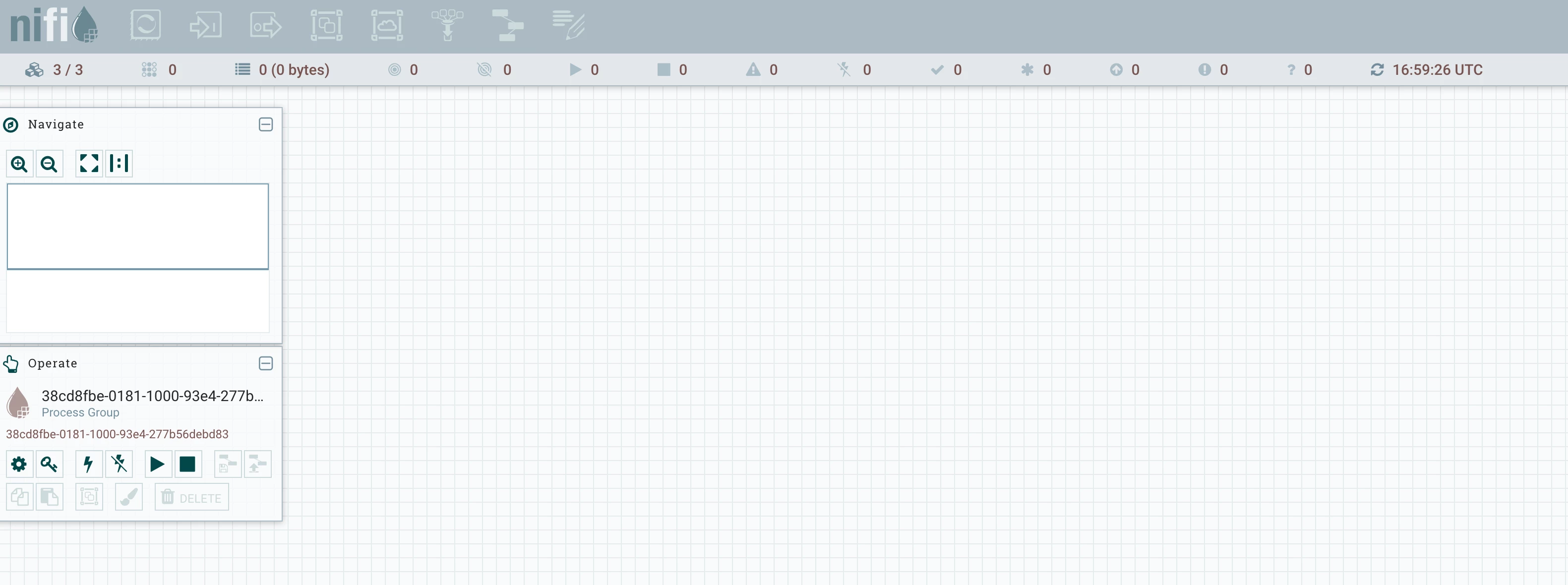
And if I perform any action like logout or add/edit user, add policy.... I get below error message: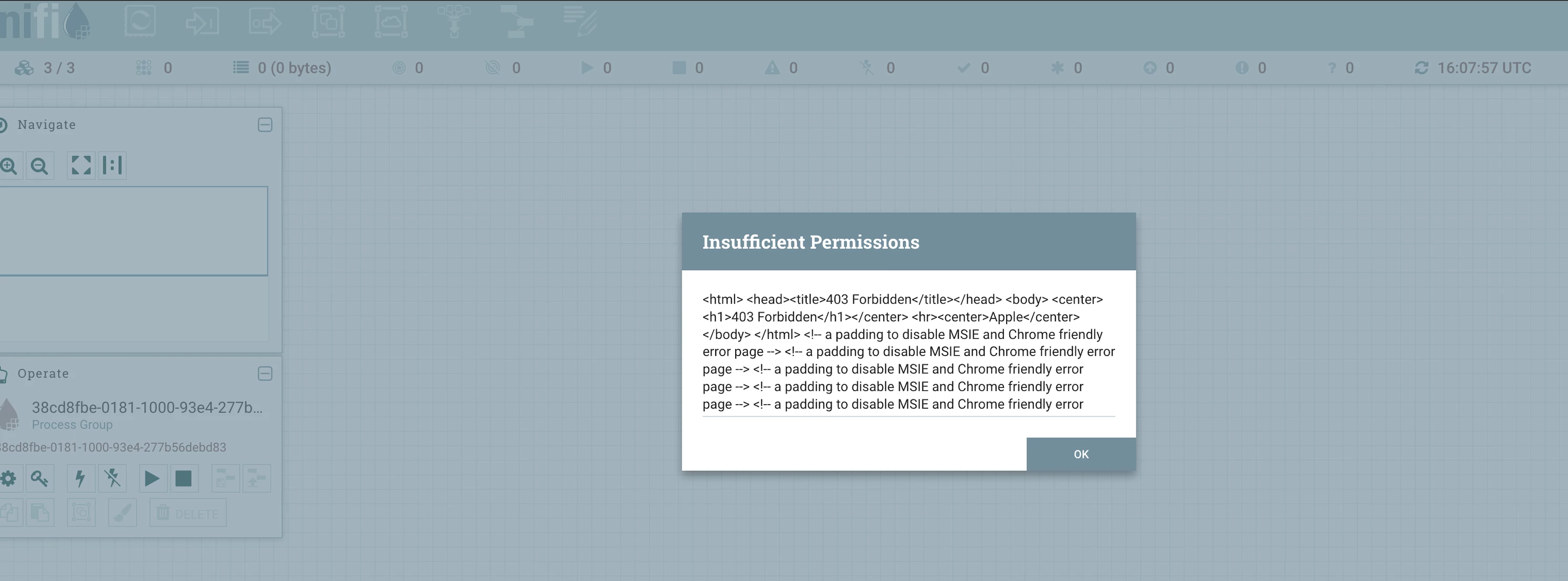
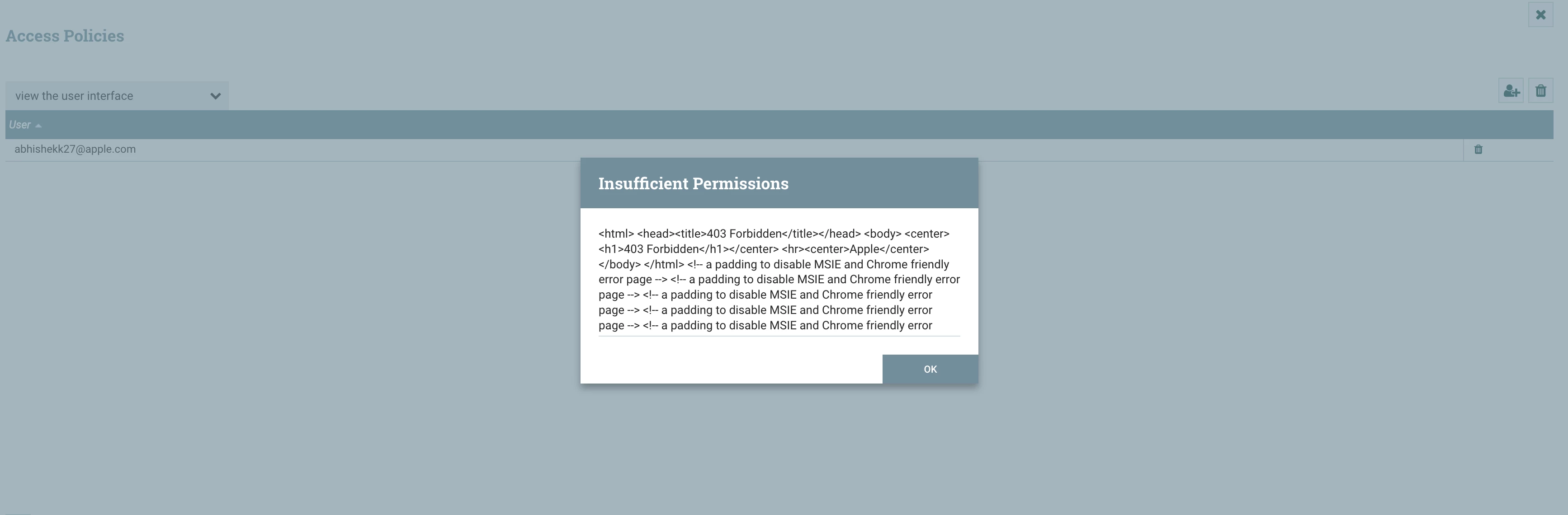
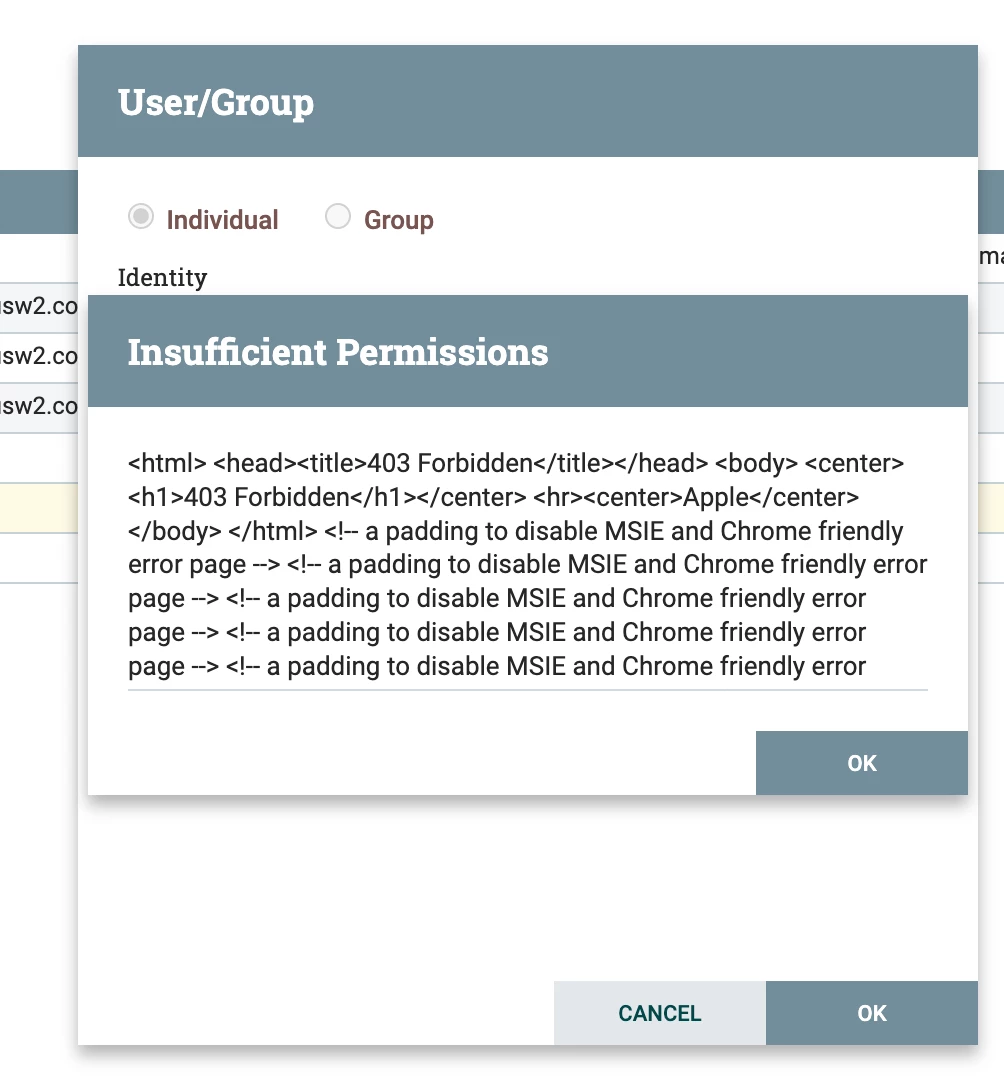
I have similar setup with NIFI version 1.10.0, and it is working fine. But with Nifi-1.15.0 or Nifi-1.16.0 I am unable to perform any action.
Any help would be highly appreciated.