Our Community is getting an upgrade! To get everything ready for the relaunch, we’ll be placing the site in read-only mode starting September 21st. We really appreciate your understanding while we get things set up behind the scenes. Catch up on all the exciting details about the move here. Need help or have questions? Drop us a line at [email protected]
Created on 01-25-201808:10 PM - edited 08-17-201909:21 AM
Objective
This article highlights some of the latest UI enhancements added in Apache NiFi 1.5.0.
Environment
The examples shown in the article utilized the following environment and components:
Mac OS X 10.11.6
Apache NiFi 1.5.0
"Primary Node" Processors Identification
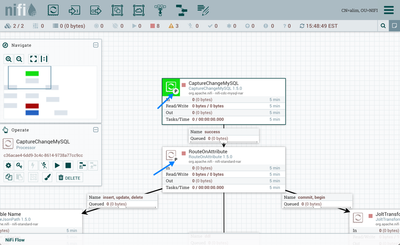
In a NiFi Cluster, processors that have been configured for "Primary node" execution are now identified in the UI by a "P". On the canvas, the "P" is visible next to the processor icon:
The "P" is also shown in the Processors tab on the Summary page, specifically in the Name column:
Finding Processors Quickly in the Summary Page
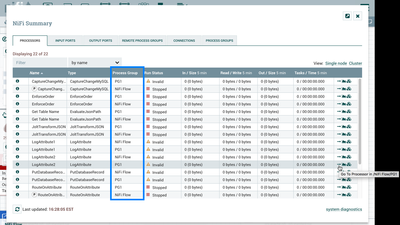
If your flow has hundreds of processors, it can be difficult differentiating between them in the Summary page (accessible from the top-right Global menu). On the Processors tab, a "Process Group" column has been added to display the name of the parent process group containing the component:
Additionally, when hovering over the "Go to location" button the tooltip now includes the path of the component.
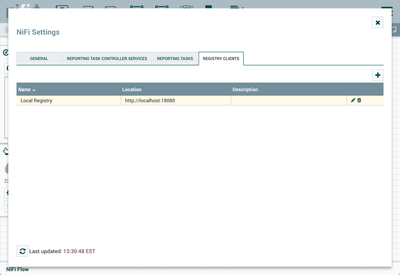
The NiFi Settings window (accessible from Controller Settings in the top-right Global menu) now has a "Registry Clients" tab where you can connect NiFi to a NiFi Registry:
Importing a Flow
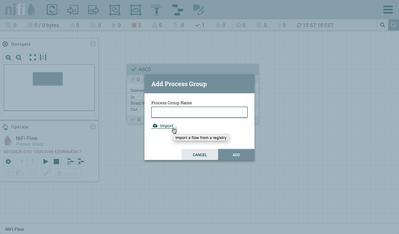
If your NiFi instance is connected to an active Registry, when adding a process group to the canvas there is also an option to "Import" a versioned flow:
Selecting "Import" prompts the user to choose a version of a flow to add to the canvas:
Version States
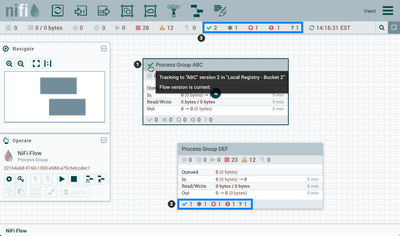
There are new icons that show:
the version state of an individual process group
the count of the statuses of versioned process groups within a process group
the count of the statuses of versioned process groups in the root process group
Here are the meanings of each icon/state:
Up to date
Locally modified
Stale
Locally modified and stale
Sync failure
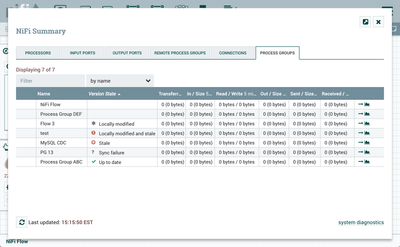
Version state information is also shown in the "Process Groups" tab of the Summary Page: