Our Community is getting an upgrade! To get everything ready for the relaunch, we’ll be placing the site in read-only mode starting September 21st. We really appreciate your understanding while we get things set up behind the scenes. Catch up on all the exciting details about the move here. Need help or have questions? Drop us a line at [email protected]
Created on 08-23-201802:08 PM - edited on 04-21-202606:27 AM by GrazittiAPI
Introduction
A few weeks ago, I published an article called Determining the big 5 traits of Personality Psychology of news articles using NiFi, Hive & Zeppelin. Since then, I have worked diligently to improve on this first iteration, with the objective to mock up at the heart of every company today: create an end-to-end platform that uses machine learning to not only generate insights, but keeps improving and feeding consumer applications.
While doing this work was a way for me to get into the needy-greedy of the latest Hortonworks tools, I decided to share it with the world in the form of a series of tutorial articles, because I believe it is a great way to get familiar with the stack.
Architecture overview
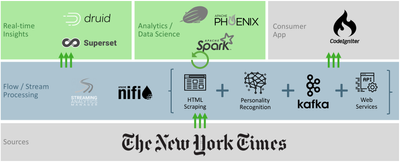
Luckily, the Hortonworks platform has all the elements needed to create this end-to-end platform. The figure below gives an overview of this series of articles architecture:
As you can see, the goal of this platform is to:
Ingest data from news articles (directly from the NYT API at first, then from other RSS feeds)
Using Nifi and SAM, read the meta-data of the extracted articles, scrape their content, run personality recognition on their authors, then expose the result via Kafka for Druid consumption, directly pushing to HBase/Phoenix for offline analytics and "micro" services for consumer applications
Generate real time insights on this computed data via Druid and Superset
Enable Analytics & model training on the data stored in HBase using Zeppelin notebooks & Spark, that would then feed back the personality recognition modes
Enable custom application to consumer the data extracted and analyzed
Agenda
This series of article will be composed of 4 parts: