The configuration file is a json file stored under
~/.sparkmagic/config.json
To avoid timeouts connecting to HDP 2.5 it is important to add
"livy_server_heartbeat_timeout_seconds": 0
To ensure the Spark job will run on the cluster (livy default is local),
spark.master needs needs to be set to yarn-cluster. Therefore a conf object needs to be provided (here you can also add extra jars for the session):
The
proxyUser is the user the Livy session will run under.
Here is an example
config.json. Adapt and copy to ~/.sparkmagic
Start Jupyter Notebooks
1) Start Jupyter:
$ cd <project-dir>
$ jupyter notebook
In Notebook Home select
New -> Spark or New -> PySpark or New -> Python
2) Load Sparkmagic:
Add into your Notebook after the Kernel started
In[ ]: %load_ext sparkmagic.magics
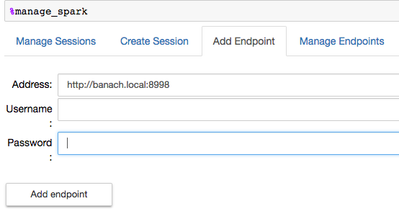
3) Create Endpoint
In[ ]: %manage_spark
This will open a connection widget
Username and password can be ignored in non secured clusters
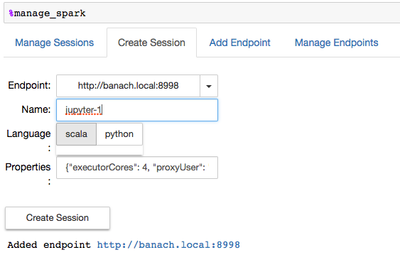
4) Create a session:
When this is successful, create a session:
Note that it uses the created endpoint and under properties the configuration on the config.json.
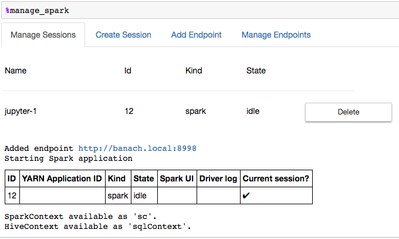
When you see
Spark session is successfully started and
Notes
Livy on HDP 2.5 currently does not return YARN Application ID
Jupyter session name provided under Create Session is notebook internal and not used by Livy Server on the cluster. Livy-Server will create sessions on YARN called livy-session-###, e.g. livy-session-10. The session in Jupyter will have session id ###, e.g. 10.
For multiline Scala code in the Notebook you have to add the dot at the end, as in
val df = sqlContext.read.
format("com.databricks.spark.csv").
option("header", "true").
option("inferSchema", "true").
load("/tmp/iris.csv")