Our Community is getting an upgrade! To get everything ready for the relaunch, we’ll be placing the site in read-only mode starting September 21st.
We really appreciate your understanding while we get things set up behind the scenes. Catch up on all the exciting details about the move here.
Need help or have questions? Drop us a line at [email protected]

Community Articles

Find and share helpful community-sourced technical articles.
Announcements
Share your experience with Cloudera on G2 and get a $25 Amazon Gift card.
Hi, I'm CLEO! Something exciting is coming to the Community. Stay Tuned!

Labels (2)
avatar
Cloudera Employee

Prior Ranger Version 0.6 it was a common scenario that security admins created per users policies, e.g. grant a user access to project databases (hive) or special HDFS directories.

Initially, a policy was created for each user so the admins ended up to manage about thousands of policies. Especially HDFS policies often had the name in the path, e.g. /user/demo/USERNAME/ *.

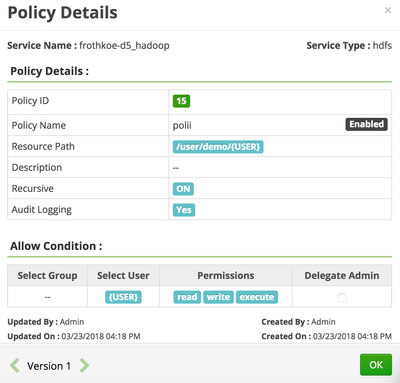
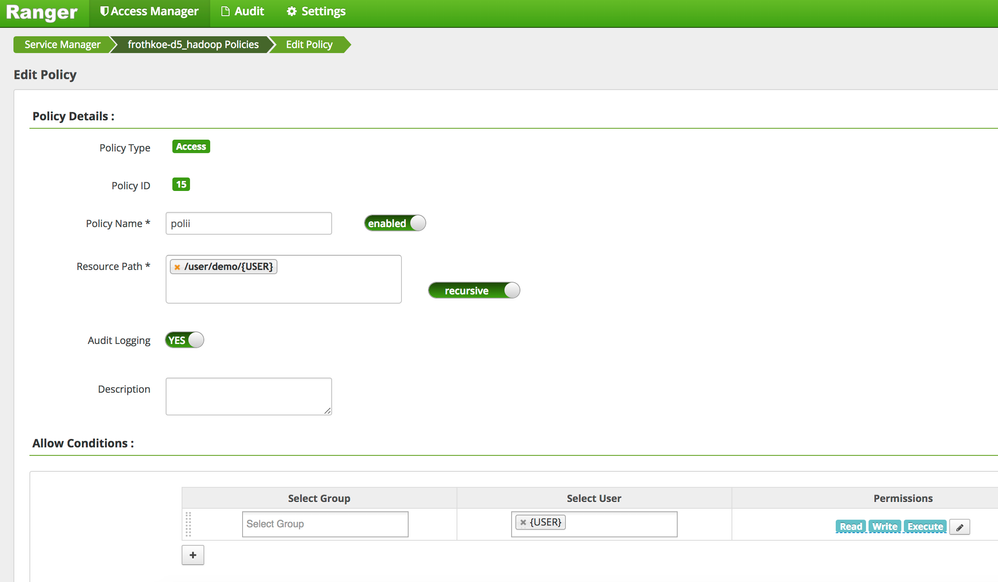
As Ranger 0.6 introduces the user variable, now the security admin have only to create one policy that looks like this in the path: /user/demo/{USER}/ * and assign the appropriate user permissions for the directory.

66382-screen-shot-2018-03-23-at-162452.png

The user can immediate access and use the new HDFS directory with enforced user permissions.

dummy_1$ hdfs dfs -copyFromLocal tst.x1 /user/demo/dummy_1
dummy_1$ hdfs dfs -ls /usr/demo/dummy_1
Found 1 items
-rw-r--r-- 3 dummy_1 hdfs19001 2018-03-23 15:36 /user/demo/dummy_1/text.txt

With the use screen-shot-2018-03-23-at-165124.pngof user variables now the security administrators can create more dynamic policies that dramatically reduced the amount of policies in the environment.


screen-shot-2018-03-23-at-162530.png
5,485 Views
Comments
avatar

A small correction. It's introduced in Ranger 0.7 and policies should look like this:

//HDFS
resource: path=/home/{USER}
user: {USER}

//Hive
resource: database=db_{USER}; table=*; column=*
user: {USER}

where {USER} would substitute the user id of the currently logged in user.

Version history
Last update:
‎08-17-2019 09:13 AM
Updated by:
Contributors