Created on 03-18-201705:27 PM - edited 08-17-201901:45 PM
HBase along with Phoenix is one of the most powerful NoSQL combinations. HBase/Phoenix capabilities allow users to host OLTPish workloads natively on Hadoop using HBase/Phoenix with all the goodness of HA and analytic benefits on a single platform (Ie Spark-hbase connector or Phoenix Hive storage handler). Often a requirement for HA implementations is a need for DR environment. Here I will describe a few common patterns and in no way is this the exhaustive HBase DR patterns. In my opinion, pattern 5 is the simplest to implement and provides operational ease & efficiency.
Here are some of the high level replication and availability strategies
with HBase/Phoenix
HBASE
provides High Availability within a cluster by managing region server failures
transparently.
HBASE
provides various cross DC asynchronous replication schemes
Master/Master
replication topology
Two
clusters replicating all edits, bi-directionally to each other
Master/Slave
topology replication
One
cluster replicating all edits to second cluster
Cyclic
topology for replication
A
ring topology for clusters, replicating all edits in an acyclic manner
Hub
and spoke topology for replication
A
central cluster replicating all edits to multiple clusters in a uni-directional
manner
Using
various topologies described above cross DC replication scheme can be setup as
per desired architecture
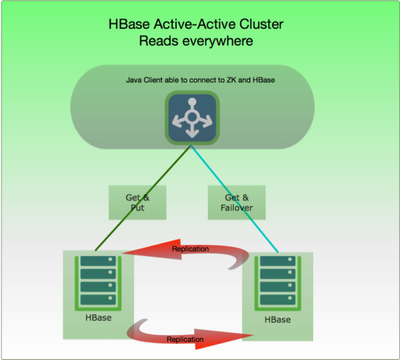
Pattern 1
Reads
& Writes served by both clusters
An
implementation of client to provide for stickiness for writes/reads based on a
session ID like concept needs to investigated
Master/Master
replication between clusters
Bidirectional
replication
Replication
post failover - recovery
instrumented via Cyclic
Replication
Pattern 2
Reads
served by both
clusters
Writes
served by single cluster
Master/Master
replication between clusters
Bidirectional
replication
Client
will failover to secondary cluster
Replication
post failover - recovery instrumented via Cyclic
Replication
Pattern 3
Reads
& Writes served
by single cluster
Master/Master
replication between clusters
Bidirectional
replication
Client
will failover to secondary cluster
Replication
post failover - recovery instrumented
via Cyclic
Replication
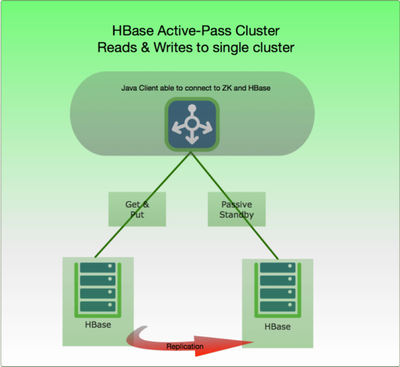
Pattern 4
Reads
& Writes served
by single cluster
Master/Slave
replication between clusters
Unidirectional
replication
Client
will failover to secondary cluster
Manual
resync required on ”primary” cluster due to unidirectional replication
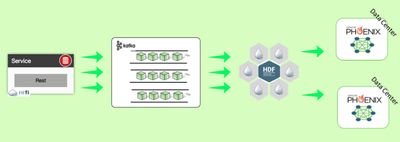
Pattern 5
Ingestion via NiFi Rest API
Supports handling secure calls and round trip responses
Push data to Kafka to democratize data to all apps interested in data set
Secure Kafka topics via Apache Ranger
NiFi dual ingest into N number of HBase/Phoenix clusters
Does Master to Master or cyclic keeps on replicating the data back and forth ? If an upsert is executed from C1 and it is propogated to C2. Now as C1 is added in C2 as peer will the replication happen to C1 back and then again to C2 (Going C1 to C2 to C1 to C2 to C1 .....)